Monday, February 11, 2008
Thursday, February 07, 2008
Willie Nelson: Twin Towers Were Imploded On 9/11

Prison Planet | February 4, 2008
Paul Joseph Watson
Straight talking American icon Willie Nelson today told a national radio show that he thought the twin towers were imploded like condemned Las Vegas casino buildings, as the country music superstar forcefully voiced his doubts about the official 9/11 story.
Agreeing with host Alex Jones that he questioned the official story, Nelson elaborated, "I saw those towers fall and I've seen an implosion in Las Vegas - there's too much similarities between the two, and I saw a building fall that didn't get hit by nothing," added Nelson, referring to WTC Building 7 which collapsed in the late afternoon of September 11.
"How naive are we - what do they think we'll go for?," asked Nelson, pointing out that his doubts began on the very day of 9/11.
"I saw one fall and it was just so symmetrical, I said wait a minute I just saw that last week at the casino in Las Vegas and you see these implosions all the time and the next one fell and I said hell there's another one - and they're trying to tell me that an airplane did it and I can't go along with that," said Nelson.
The former Highwayman, fresh from his appearance at this past weekend's superbowl, questioned why Afghanistan became an immediate target in the aftermath of 9/11 when the official story posited that mostly Saudi Arabians were responsible for the attack.
"When I get hit I like to look around and see who did it before I start swinging at everybody in the room and that's kind of what we were doing," said Nelson, "We get hit over here and then next thing you know we're jumping on everybody in the town - so (if) we got hit from Saudi Arabia, I think we've got some questions that need to be answered from those folks," said Nelson.
In light of his viewpoint, Nelson said that recent revelations concerning the impartiality of the 9/11 Commission and its close links with the White House did not surprise him.
"What does it take for us to realize we're having the wool pulled over our eyes one more time?" he concluded.
Nelson is not the first high-profile public figure to question 9/11. In March 2006, actor Charlie Sheen voiced his doubts and was followed last year by his father Martin Sheen.
Aside from celebrities - professors, scientists and other experts the world over have questioned the inconsistencies in the official story, and the topic was most recently even a subject of serious debate in the Japanese Parliament.
In December, former Italian President Francesco Cossiga told Italy's most respected newspaper, Corriere della Sera, that the attacks were run by the CIA and Mossad and that this was common knowledge amongst global intelligence agencies.
Former German Secretary of Defense Andreas von Bülow also went public in blaming American intelligence for instigating the attack.
Nelson's country music contemporaries The Dixie Chicks were savaged by the establishment when they criticized the Bush administration shortly before the invasion of Iraq. It remains to be seen whether the corporate media will dare take on Nelson for his views or whether they will just try to ignore the story as happened with Martin Sheen.
Even if they choose to ignore Nelson's comments, the power of the alternative media should organize now to get this story out.
Posted by
Floyd Anderson
at
12:47 AM
0
comments
Wednesday, February 06, 2008
Santa's Workshop - Inside China's Slave Labor Toy Factories (2004)
Posted by
Floyd Anderson
at
10:30 PM
1 comments
Monday, February 04, 2008
FBI Wants Palm Prints, Eye Scans, Tattoo Mapping
Kelli Arena and Carol Cratty
CNN
February 4, 2008
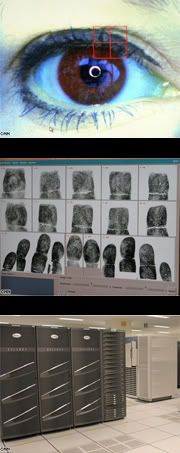
CLARKSBURG, West Virginia (CNN) -- The FBI is gearing up to create a massive computer database of people's physical characteristics, all part of an effort the bureau says to better identify criminals and terrorists.
But it's an issue that raises major privacy concerns -- what one civil liberties expert says should concern all Americans.
The bureau is expected to announce in coming days the awarding of a $1 billion, 10-year contract to help create the database that will compile an array of biometric information -- from palm prints to eye scans.
Kimberly Del Greco, the FBI's Biometric Services section chief, said adding to the database is "important to protect the borders to keep the terrorists out, protect our citizens, our neighbors, our children so they can have good jobs, and have a safe country to live in."
But it's unnerving to privacy experts.
"It's the beginning of the surveillance society where you can be tracked anywhere, any time and all your movements, and eventually all your activities will be tracked and noted and correlated," said Barry Steinhardt, director of the American Civil Liberties Union's Technology and Liberty Project.
The FBI already has 55 million sets of fingerprints on file. In coming years, the bureau wants to compare palm prints, scars and tattoos, iris eye patterns, and facial shapes. The idea is to combine various pieces of biometric information to positively identify a potential suspect.
A lot will depend on how quickly technology is perfected, according to Thomas Bush, the FBI official in charge of the Clarksburg, West Virginia, facility where the FBI houses its current fingerprint database.
"Fingerprints will still be the big player," Bush, assistant director of the FBI's Criminal Justice Information Services Division, told CNN.
But he added, "Whatever the biometric that comes down the road, we need to be able to plug that in and play."
First up, he said, are palm prints. The FBI has already begun collecting images and hopes to soon use these as an additional means of making identifications. Countries that are already using such images find 20 percent of their positive matches come from latent palm prints left at crime scenes, the FBI's Bush said.
The FBI has also started collecting mug shots and pictures of scars and tattoos. These images are being stored for now as the technology is fine-tuned. All of the FBI's biometric data is stored on computers 30-feet underground in the Clarksburg facility.
In addition, the FBI could soon start comparing people's eyes -- specifically the iris, or the colored part of an eye -- as part of its new biometrics program called Next Generation Identification.
Nearby, at West Virginia University's Center for Identification Technology Research, researchers are already testing some of these technologies that will ultimately be used by the FBI.
"The best increase in accuracy will come from fusing different biometrics together," said Bojan Cukic, the co-director of the center.
But while law enforcement officials are excited about the possibilities of these new technologies, privacy advocates are upset the FBI will be collecting so much personal information.
"People who don't think mistakes are going to be made I don't think fly enough," said Steinhardt.
He said thousands of mistakes have been made with the use of the so-called no-fly lists at airports -- and that giving law enforcement widespread data collection techniques should cause major privacy alarms.
"There are real consequences to people," Steinhardt said.
You don't have to be a criminal or a terrorist to be checked against the database. More than 55 percent of the checks the FBI runs involve criminal background checks for people applying for sensitive jobs in government or jobs working with vulnerable people such as children and the elderly, according to the FBI.
The FBI says it hasn't been saving the fingerprints for those checks, but that may change. The FBI plans a so-called "rap-back" service in which an employer could ask the FBI to keep the prints for an employee on file and let the employer know if the person ever has a brush with the law. The FBI says it will first have to clear hurdles with state privacy laws, and people would have to sign waivers allowing their information to be kept.
Critics say people are being forced to give up too much personal information. But Lawrence Hornak, the co-director of the research center at West Virginia University, said it could actually enhance people's privacy.
"It allows you to project your identity as being you," said Hornak. "And it allows people to avoid identity theft, things of that nature."
There remains the question of how reliable these new biometric technologies will be. A 2006 German study looking at facial recognition in a crowded train station found successful matches could be made 60 percent of the time during the day. But when lighting conditions worsened at night, the results shrank to a success rate of 10 to 20 percent.
As work on these technologies continues, researchers are quick to admit what's proven to be the most accurate so far. "Iris technology is perceived today, together with fingerprints, to be the most accurate," said Cukic.
But in the future all kinds of methods may be employed. Some researchers are looking at the way people walk as a possible additional means of identification.
The FBI says it will protect all this personal data and only collect information on criminals and those seeking sensitive jobs.
The ACLU's Steinhardt doesn't believe it will stop there.
"This had started out being a program to track or identify criminals," he said. "Now we're talking about large swaths of the population -- workers, volunteers in youth programs. Eventually, it's going to be everybody."
Posted by
Floyd Anderson
at
5:29 PM
0
comments
Monday, January 28, 2008
Sunday, January 27, 2008
Wednesday, January 16, 2008
Main Japanese Opposition Party Questions 9/11 in Parliament
Posted by
Floyd Anderson
at
6:46 PM
0
comments
Tuesday, January 15, 2008
Monday, January 14, 2008
Wesley Snipes to Go on Trial in Tax Case
David Kay Johnston
New York Times
January 14, 2008
From 1999 to 2004, the actor Wesley Snipes earned $38 million appearing in more than half a dozen movies, including two sequels to his popular vampire thriller “Blade.”
The taxes he paid in the same period? Zero.
But unlike other celebrities who find themselves on the wrong side of the Internal Revenue Service, Mr. Snipes has a flamboyant explanation: he argues that he is not actually required to pay taxes.
Mr. Snipes, who is scheduled to go on trial Monday in Ocala, Fla., has become an unlikely public face for the antitax movement, whose members maintain that Americans are not obligated to pay income taxes and that the government extracts taxes from its citizens illegally.
His trial has become the most prominent income tax prosecution since the 1989 conviction of the billionaire New York hotelier, Leona Helmsley, who went to prison for improperly billing personal expenses to her business.
Tax deniers maintain that the law only appears to require payment of taxes. All their theories have been rejected by the courts, including the one invoked by Mr. Snipes, which is known as the 861 position, after a section of the federal tax code.
Adherents say a regulation applying the 861 provision does not list wages as taxable, though it does say that “compensation for services” is taxable. The courts have uniformly rejected all such theories, and eight people have been sentenced to prison after not paying taxes based on the 861 argument.
Despite the court rulings, juries have acquitted some prominent tax resisters in recent years, and failed prosecutions have encouraged others to join. Even when the government has failed to obtain convictions, it succeeded in collecting the taxes through civil enforcement.
J. J. MacNab, a Maryland insurance analyst who tracks people who deny they owe taxes and has testified before Congress about the movement, said that an acquittal of Mr. Snipes would be a severe setback for the I.R.S.
“He will get more press and attention than any other victory by the tax deniers, and the growth in new members will be exponential,” she said.
Mr. Snipes, 45, is charged with two felonies: conspiracy to defraud the government and filing a false claim for a $7 million refund (a claim for the year 1997, before he stopped paying taxes). He is also charged with failing to file tax returns for the six years starting in 1999. Prosecutors say they intend to show that Mr. Snipes moved tens of millions of untaxed dollars offshore and gave the government three worthless checks totaling $14 million to cover some taxes.
In court papers and interviews, Mr. Snipes says that he is not guilty and that he acted on the advice of two tax professionals. They are being tried alongside him and are promoters of the 861 position and other tax theories.
One is Douglas Rosile, who was stripped of his accounting license in 1997. The other is Eddie Kahn, who has served prison time for tax crimes. Both are under federal court order to stop promoting tax evasion, including the 861 position.
The lawyer representing Mr. Snipes at trial is Robert Bernhoft of Milwaukee, who has been barred by court order since 1999 from selling a program under which he said people could legally stop paying income taxes.
Mr. Snipes, who grew up in the Bronx, is best known for tough-guy roles in movies like “Blade,” “U.S. Marshals,” and “The Passenger,” but he also starred in films by Spike Lee (“Jungle Fever,” “Mo’ Better Blues”) and Ron Shelton (“White Men Can’t Jump”).
His involvement with the tax resistance movement may stem from his association with the Nuwaubians, a quasi-religious sect of black Americans who promote antigovernment theories and who set up a headquarters in Georgia in the early 1990s.
In 2000, Mr. Snipes sought a federal permit for a military training compound on land next to the Nuwaubian camp; the Bureau of Alcohol, Tobacco and Firearms rejected the request.
“Snipes is already drawing whole new demographics to the movement,” Ms. MacNab added. “Tax protesters used to be white, 50 or older, blue-collar, rural and often connected to racist movements, but Snipes is young, urban and famous.”
She and others said the movement got a boost in 2005 when a jury acquitted Joseph Banister, a former criminal investigator for the I.R.S., who used his acquittal as proof that his views on the tax law were correct. One problem with that case was that even though his co-defendant, Al Thompson of Lake Shasta, Calif., was acquitted of conspiracy in a separate trial, Mr. Thompson is serving six years in prison for failing to withhold taxes from his employees and turn the money over.
Federal prosecutors also failed to convict a Louisiana lawyer, Tom Cryer, who, like Mr. Snipes, said he sincerely believed that he was not required to pay taxes. Another resister, Robert Lawrence of Peoria, Ill., had his case dropped in 2006 after arguing that tax forms violate the federal Paperwork Reduction Act — a strategy that had been falling out of favor among tax opponents but has since gained new adherents. Both men were still liable for the taxes after their cases.
Prosecutors also failed to convict a FedEx pilot, Vernice Kuglin of Memphis, who said she wrote the I.R.S. asking what law makes her liable for taxes, but got no response. She later signed papers conceding she owed more than $600,000 in taxes, and last week her goods, including her 14-year-old vehicle, were auctioned in Memphis. Ms. Kuglin said that despite the court filing, she continues to believe that she does not owe taxes.
Tax specialists and lawyers say that the Snipes case hinges on whether he can persuade jurors that he sincerely believed that he did not have to pay taxes, while prosecutors will argue that he was just trying to avoid them. The Supreme Court has ruled that people can make such an argument, but two leading defense lawyers said that Mr. Snipes might have a hard time using it as a defense.
Michael Louis Minns, a Houston lawyer who has defended and won acquittals for tax protesters, said that the three bad checks that Mr. Snipes sent the government to cover $14 million of taxes would seem to destroy a defense based on that argument.
“You can win acquittal with a good-faith defense that you sincerely believed you do not have to pay taxes,” Mr. Minns said. “But not if you make inconsistent claims.”
William Cohan, a lawyer in Rancho Santa Fe, Calif., who also represents tax opponents, said another hurdle is the refund claim form signed by Mr. Snipes. The signature statement, or jurat, was altered so that instead of saying it was signed under penalty of perjury, the word “no” was inserted before “penalty.”
“That’s just devastating because if you sincerely believe you are not required to pay taxes, why would you alter the jurat?” Mr. Cohan said.
Posted by
Floyd Anderson
at
8:01 PM
0
comments
Tuesday, January 01, 2008
Kay Griggs Interview - Military Black Ops & Blackmail in the U.S. Government (1998)
Kay Griggs, wife of colonel George Griggs, USMC (retired USMC Commandant): 29th Commandant of the Marine Corps, found her husband's diary which contains details of homosexual blackmail in the top ranks of the US Marine Corps and names leading politicians and military leaders. Kay Griggs' information about the US government also comes from observations and people she met. She exposes initiation rituals, the raping of young men and blackmail and murders to keep people quiet. Much of this, according to Griggs, is related to secret society activity and she names figures like Henry Kissinger and a string of other top government individuals.
Colonel George Griggs was a Marine Corps Chief of Staff as well as head of NATO's Psychological Operations. He was also, his wife realized, entirely mind-controlled. Kay, a self-declared Christian, became privy to the real workings of the United States military, leadership training, drug-running and weapons sales, and the secret worldwide camps that train professional assassins.
These interviews with Pastor Rick Strawcutter of Adrian, Michigan were conducted in 1998, before September 11th and the installation of U.S. President George W. Bush. Kay Griggs' report of world events and the power elite paints a picture that begins to explain the hows and whys of our current global scenario.
Posted by
Floyd Anderson
at
6:15 PM
5
comments
Friday, December 28, 2007
Tuesday, December 25, 2007
San Antonio 12/24 & 12/25
The Alamo, San Antonio 12/24/2007:


Mormon temple, San Antonio 12/25/2007:
Posted by
Floyd Anderson
at
5:30 PM
0
comments